BTU Calculator: What Size AC Do I Need?
Quick answer: a common rule is 20 BTUs per square foot of cooling. A 12×12 ft room needs about 2,880 BTUs, so a small window unit (5,000–6,000 BTU) covers it. Here's the full sizing method.
- BTU rule of thumb
- Adjustments
- Worked example
- Why oversizing hurts
- Portable vs window
- Common mistakes
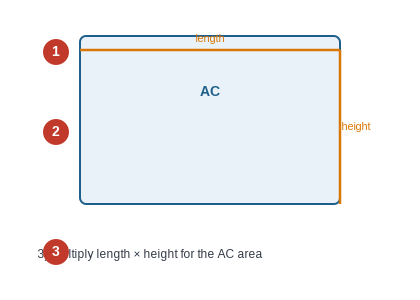
BTU rule of thumb
BTUs measure cooling output. The standard starting point for a room:
Room area (sq ft) × 20 = BTUs needed. This assumes about 8-ft ceilings, average insulation, and typical sun exposure. Use it as a baseline, then adjust. For a 10×12 room that's 120 sq ft × 20 = 2,400 BTU baseline; a 12×15 room is 180 × 20 = 3,600.
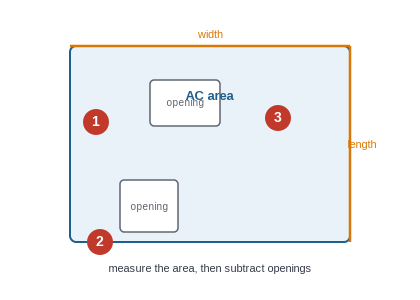
Adjustments
| Factor | Adjustment |
|---|---|
| High ceiling (10 ft+) | Add ~10–20% |
| Lots of west-facing sun | Add ~10% |
| Kitchen (heat from appliances) | Add ~4,000 BTU |
| Shaded / north-facing | Subtract ~10% |
| More than 2 people | Add ~600 BTU each |
These adjustments stack, so a hot west-facing kitchen with a high ceiling can easily land 30% above the raw area rule. Do the area baseline first, then add every factor that applies to your room before you pick a unit size.
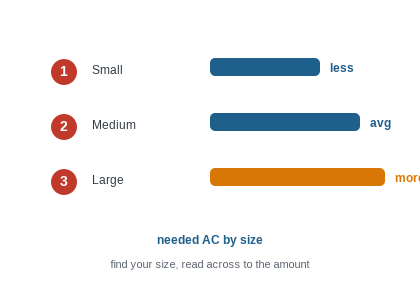
Worked example
- Room = 12 × 12 = 144 sq ft
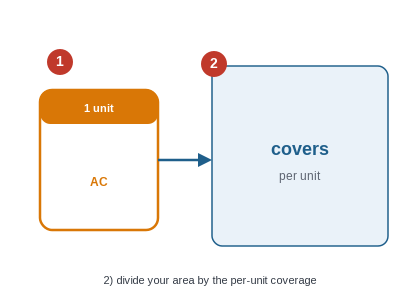
- Baseline = 144 × 20 = 2,880 BTU
- Add 10% for a west-facing window → ~3,170 BTU
- Round up to the nearest standard size → 5,000 BTU window unit (smallest common size)
Why oversizing hurts
Bigger isn't better. An oversized AC short-cycles — it cools the air fast, shuts off, and never runs long enough to dehumidify the room, leaving it clammy and wasting energy. Buy slightly under the top of your range rather than overshooting it.
Short-cycling also wears the compressor faster. A unit that's right-sized runs in longer, steadier cycles, dehumidifies properly, and keeps the room feeling cool rather than just "cold air then damp."
Portable vs window
Window units are generally more efficient and cheaper per BTU than portable units. Portables are easier to place but vent less effectively and often use a bigger BTU rating for the same cooling. Size both with the same BTU math, then favor the window unit where possible.
Common mistakes
- Using length × width only and ignoring height and sun. Both change the load.
- Oversizing "to be safe." It cools poorly and costs more.
- Forgetting a kitchen or many occupants. Both add heat.
- Mixing BTU with wattage. They measure different things — size on BTUs.
- Not stacking adjustments. Each factor compounds toward the real load.
FAQ
A 12×12 ft room is 144 sq ft, so it needs about 2,880 BTU baseline. A 5,000 BTU window unit comfortably covers it even with adjustments.
A 5,000 BTU unit typically cools rooms up to about 150 square feet — roughly a 12×12 ft room — under average conditions.
It's a good baseline for typical rooms. Adjust for high ceilings, sun exposure, kitchens, and occupant count, then round up to a standard unit size.
No. Oversized ACs short-cycle, fail to dehumidify, and waste energy. Match the BTU to the room and slightly round up to a standard size, but don't overshoot the range.