How to Calculate Deck Baluster Spacing (IRC Code)
Quick answer: use (span + baluster width) ÷ (baluster width + 4 in). For a 10-ft span with 1.5-in balusters that's (120 + 1.5) ÷ 5.5 ≈ 22 balusters, centered evenly so the clear gap never exceeds 4 inches. Here's the code and the worked example.
Step 1: the 4-inch rule
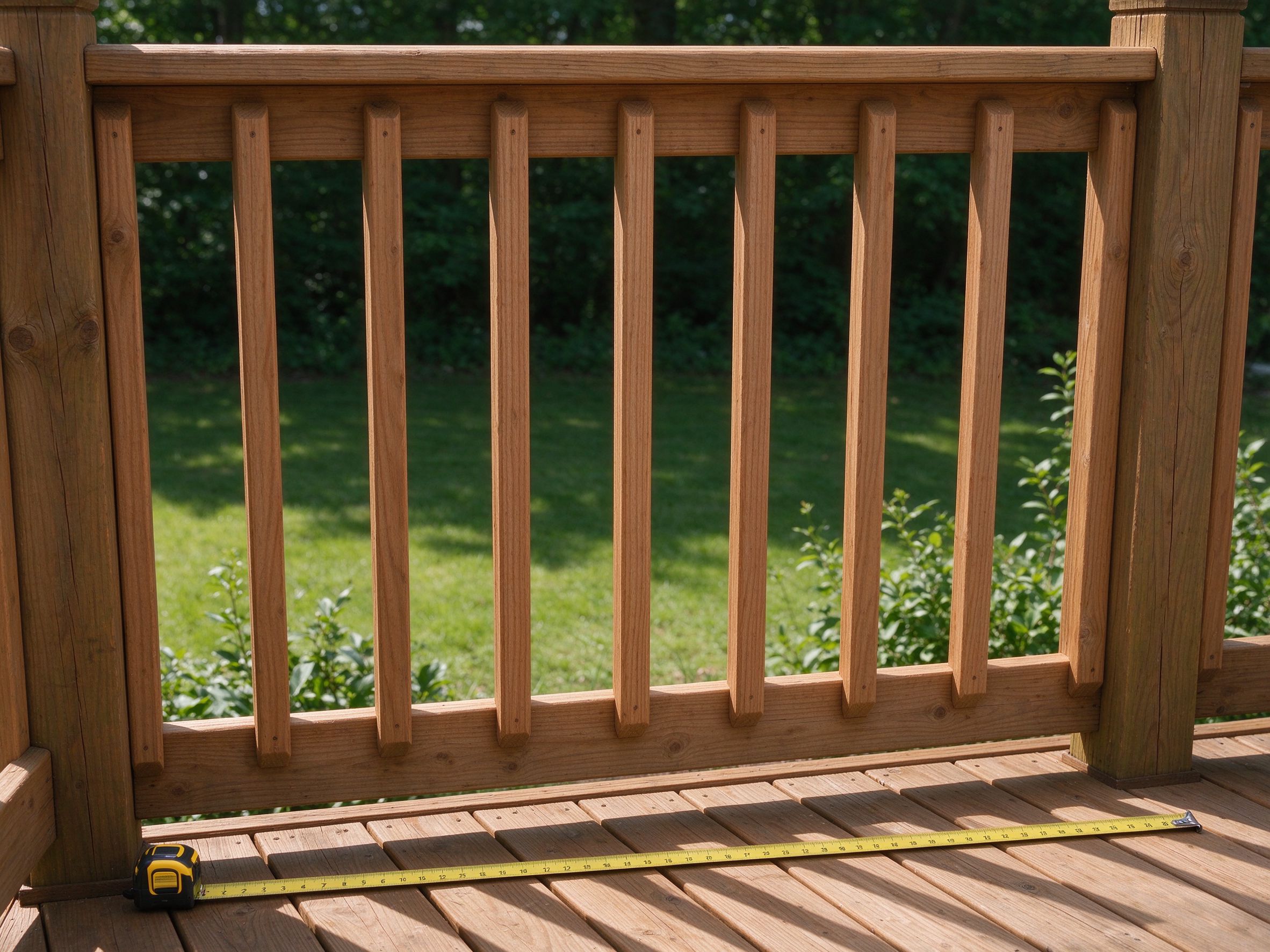
US residential decks follow the 4-inch rule (IRC guardrail requirements): the clear opening between balusters can't exceed 4 inches. That's the gap between adjacent balusters, not center-to-center. Smaller gaps are fine; the code is the maximum, and inspectors measure the clear space.
Step 2: the spacing formula
To find how many balusters you need across a span between posts:
(span + baluster width) ÷ (baluster width + 4 in) = balusters
Worked example — a 10-ft span with 1.5-in balusters:
- Span = 120 in; 120 + 1.5 = 121.5
- Baluster width + 4 = 5.5
- 121.5 ÷ 5.5 ≈ 22 balusters
- Center them so the end gaps match
Balusters by span
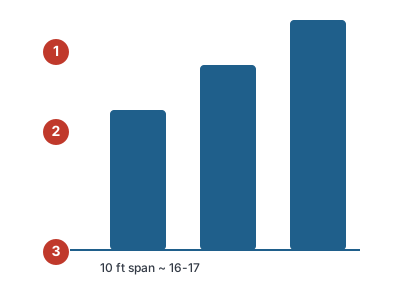
Using 1.5-in balusters and a 4-in max gap:
| Span | Balusters | Effective gap |
|---|---|---|
| 6 ft | 13 | ~4.0 in |
| 8 ft | 17 | ~4.0 in |
| 10 ft | 22 | ~3.9 in |
| 12 ft | 26 | ~4.0 in |
Center the layout
An even, centered layout is what looks right and passes inspection. After you know the count, mark the first and last balusters, then divide the remaining space into equal gaps. A stair or angled section uses the same formula per section — measure each span between posts separately rather than stretching one layout.

Common mistakes
- Measuring center-to-center. The code cares about the clear gap; a wider baluster leaves less opening at the same center spacing.
- Forgetting to measure each section. Posts rarely land at equal spans; do each one separately.
- Rounding down. Round up the baluster count so the gap stays ≤ 4 in.
- Not centering. An off-center layout leaves one awkward gap at an end.