Square Footage of Odd-Shaped Rooms: How to Measure
Quick answer: break an odd room into rectangles, triangles, and semicircles, measure each in feet, and add the areas together. Here's the method for L-shapes, triangles, and curves.
- The split-and-add rule
- L-shaped rooms
- Triangular rooms
- Curved rooms
- Worked example
- Common mistakes
The split-and-add rule
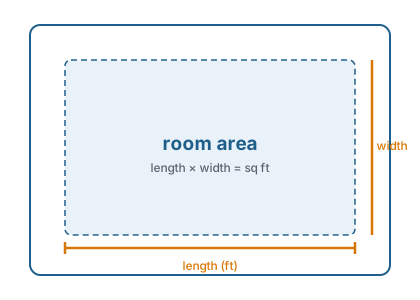
Any odd-shaped room can be split into simple shapes you know how to calculate. Rectangles = length × width, triangles = base × height ÷ 2, semicircles = πr² ÷ 2. Measure each piece in feet, add the results, and you have the total — no special tools needed.
L-shaped rooms
Split an L into two rectangles. A 12×10 section plus a 6×4 section: 120 + 24 = 144 sq ft. Draw it out on paper, label each rectangle's length and width, and add. This covers most kitchens with peninsulas and living-dining combos.
Triangular rooms
For a triangle, measure the base and the height (the straight-up distance to the peak), then use base × height ÷ 2. A 12-ft base with an 8-ft height is 12 × 8 ÷ 2 = 48 sq ft. The height is measured perpendicular to the base, not along the sloped wall.
Curved rooms
For a semicircle or curved bay, measure the radius, square it, multiply by 3.14, and halve it. A curved bay with a 4-ft radius is about 3.14 × 16 ÷ 2 ≈ 25 sq ft. For a full circle, skip the halving. Treat small curves as part of the nearest rectangle and round conservatively.
Worked example
A living room that's 15×12 with a 4-ft semicircle bay:
- Main rectangle = 180 sq ft
- Bay = 3.14 × 16 ÷ 2 ≈ 25 sq ft
- Total ≈ 205 sq ft
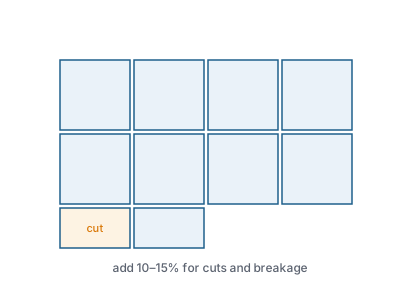
That's the number you'd use for flooring — then add 10% waste.
Common mistakes
- Measuring the slope as height. Height is perpendicular to the base.
- Forgetting the halving on a semicircle. Doubles the bay area.
- Mixing units. Keep everything in feet or inches consistently.
- No waste. Odd shapes create more off-cuts, so add extra.
FAQ
Split the L into two rectangles, measure each in feet, multiply for each area, and add them together. For a 12×10 plus 6×4 section, that's 120 + 24 = 144 sq ft.
Measure the base and the height (the straight-up distance to the peak), then use base × height ÷ 2. A 12-ft base with a 8-ft height is 12 × 8 ÷ 2 = 48 sq ft.
For a semicircle, measure the radius, square it, multiply by 3.14, then halve it. A curved bay with a 4-ft radius is about 3.14 × 16 ÷ 2 ≈ 25 sq ft.
Material is priced per square foot, so an accurate count prevents over- or under-buying. Add 10% waste for flooring and tile; a miscount on an odd room wastes money or leaves you short.